What Does a Mature Civilisation Look Like?
Our capability is compounding and our judgement is not. If maturity is the gap between what a civilisation can do and what it can handle doing, it is worth asking what closing that gap would actually require.
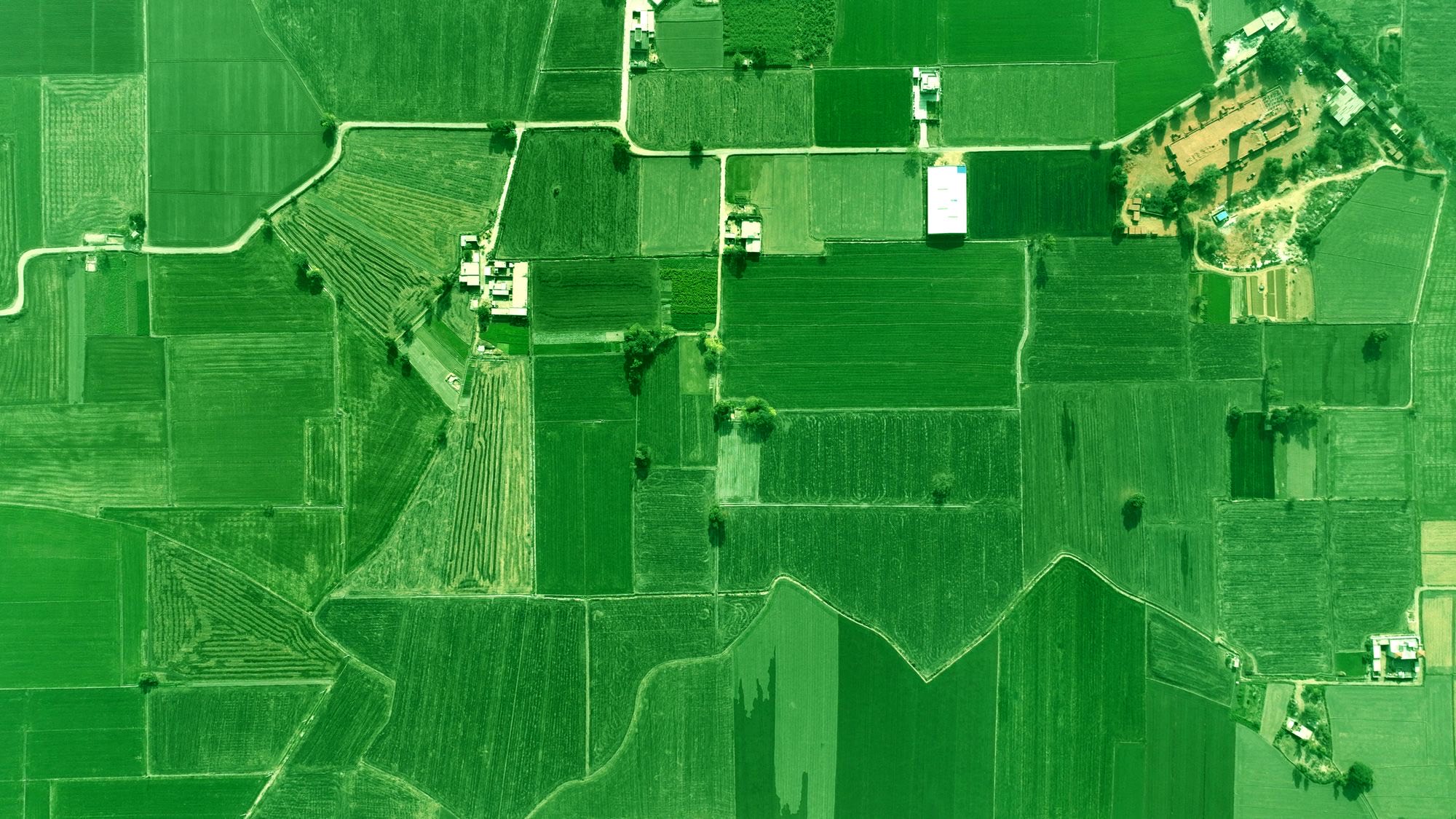
Progress is usually measured as capability. What can we build, lift, compute, cure, reach. By that measure the last century is the most successful period in the history of the species by an enormous margin, and the curve is still going up.
Maturity is a different measurement. It is not what a civilisation can do. It is the gap between what it can do and what it can handle having done.
That gap is the interesting number, and there is no particular reason to expect it to close on its own. Capability compounds, because each capability makes the next one cheaper. Judgement does not compound. It has to be rebuilt, more or less from scratch, by every generation and every institution that inherits the machinery.
The photograph at the top
Look again at the fields.
That pattern is one of the most consequential things our species has ever made. Intensive cereal agriculture in the Punjab, from the mid 1960s onward, did what it was designed to do: it turned a region facing famine into a surplus producer, and it did it in about a decade. Measured as capability, it is close to a miracle, and the people who built it were not fools or villains. They were solving the problem in front of them, which was that people were going to starve.
The problem behind the problem arrived later. Yields of that kind needed water, and the water came from underground, and underground water is a stock rather than a flow. The region has been drawing down an aquifer for decades to keep the pattern in the photograph looking like that.
India’s Central Ground Water Board measures this directly, as a stage of extraction: what is taken out each year against what can be replaced. Above 100 per cent, an area is classified over-exploited. In the 2025 Dynamic Ground Water Resources Assessment, Punjab was at 156 per cent, the highest of any state in India. Two years earlier it was 164.
Those are not numbers about a bad harvest. They describe a region that has been spending capital as though it were income for half a century, and knows it.
This is the shape the gap usually takes. Not a mistake, not greed, not stupidity. A real solution to a real problem, deployed at a scale that outran the timescale anyone was thinking on.
Maturity is not what we usually mean by advanced
A few things it is not.
It is not wealth. Wealth buys capability, which is the thing that outran us in the first place.
It is not technology. Every technology is an amplifier, and an amplifier improves the signal and the noise equally.
It is not peace by exhaustion. A civilisation that stops fighting because it has nothing left to fight with has not learned anything transferable.
It is not stopping. The version of maturity that means doing less, more cautiously, forever, is not maturity. It is a different failure mode, and it is unavailable anyway to a population this size with these needs.
Candidate components
Here is a first attempt at what would actually have to be true, with the caveat that this is the part of the essay most likely to be wrong and most in need of argument.
Decisions on the timescale of consequences. Most of our institutions optimise over an electoral cycle, a reporting quarter, or a career. Most of our serious consequences land outside all three. Any mechanism that reliably closes that mismatch is worth more than most technologies.
Managing a shared resource before it collapses, not after. The historical record is mostly a record of failure at this. But not entirely, and the exceptions are the most useful things we have.
The Montreal Protocol is the strongest counterexample we have. The most recent completed WMO and UNEP Scientific Assessment of Ozone Depletion, published in 2022, projects the ozone layer returning to its 1980 values by around 2040 for most of the world, 2045 over the Arctic and 2066 over the Antarctic. The next assessment is due at the end of 2026.
Note the timescales. A problem identified in the 1970s, acted on in 1987, and resolving around 2066: a repair that takes roughly a century from diagnosis, agreed by people who would not live to see it finish. That is what acting on the timescale of consequences actually looks like, and it is the only example of its kind at planetary scale.
What makes it interesting is not that it worked. It is why it worked, and the honest answer is not flattering. The harm was legible, the mechanism was simple enough to explain in a sentence, the substitutes were available, and the number of firms that had to change behaviour was small. Change the value of any one of those and it probably fails. Maturity would mean being able to do it when the conditions are not that convenient.
Institutions that can act on evidence they did not want. Every organisation can respond to findings that confirm its direction. Very few can respond to findings that invalidate a decade of their own work, and the ones that can are extraordinarily valuable.
Repair counted as production. We measure what is made. We mostly do not measure what is restored, and what is not measured does not get funded, staffed or promoted for.
Treating other life as resident rather than inventory. Not as sentiment. As accounting. A system that appears on the books only when it is extracted is a system with no defence at the moment the decision is made.
The test we keep failing
Across all of these there is a common structure.
The harm is diffuse, the benefit is concentrated, and the timing is wrong. The person who gains is identifiable and present. The person who pays is statistical and later. Every individual decision is locally rational and the aggregate is a disaster, and nobody involved has to be acting in bad faith for that to happen.
Almost everything difficult about this century has that shape.
Which suggests the useful work is not mostly moral. Telling people to want different things has a long record of not working. The useful work is structural: changing what is counted, who is in the room, and over what period the answer is judged, so that the locally rational decision stops being the collectively ruinous one.
That is less inspiring than a change of heart. It has the advantage of occasionally happening.
Why this is the right question
There is a version of this essay that asks whether an older civilisation somewhere else would think we were ready. That version is unanswerable and, worse, it is comfortable: it turns a question about our own conduct into speculation about an audience.
The question here is answerable, because the evidence is entirely ours. We can see what we build, how fast, and how well we handle the consequences. We can count the cases where we managed it and the cases where we did not, and we can look at what distinguished them.
That is a research programme rather than a mood.
The gap between capability and judgement is the defining fact of the present moment, and it is measurable. Closing it is probably the whole of the work.